Pool Filter Pressure High? Read the Gauge Like a Pro (the psi Ladder + the Mirror Problem)

High gauge pressure means something downstream of the pump is restricting flow — and in cartridge filters, roughly 90% of the time it’s simply a loaded cartridge: clean it (the standard trigger is +8–10 psi over your clean baseline). Above ~30–35 psi, stop running the pump — that range is bypass-valve, tank-lid-bolt, and safety-switch territory. And know the mirror problem before you diagnose: low pressure with weak suction is a suction-side blockage — the gauge distinguishes the two halves of your system.
The pressure gauge is the most information-dense instrument on your pool equipment pad, and the most ignored. It’s a cheap dial (they fail, they fog, they get sunbaked) that reports the entire hydraulic state of everything downstream of the pump. One r/pools exchange captures the usual state of play: a pool owner reporting “pressure seems high, maybe 25?” — asked what it reads after a clean filter, he said it had never occurred to him to check. Without a baseline, “high” is a vibe. With one, it’s a diagnosis.
Quick Answer: The psi Ladder


| Gauge reading | Diagnosis | Action |
|---|---|---|
| Clean baseline (right after new/cleaned cartridge) | Healthy system reference | Write it down — everything below reads against it |
| +4 psi over baseline | Normal loading in progress | No action; note the trend |
| +8–10 psi over baseline | Cartridge loaded — the manufacturer-standard cleaning trigger | Full clean cycle (cleaning guide) |
| +15 psi and cleaning doesn’t restore baseline | Not (only) the cartridge — check the ladder’s next rungs | Valve checks, then cartridge end-of-life, then gauge |
| 30–35+ psi | Danger zone — bypass valves open, lid seals strain, tank shells are rated here | Shut the pump off before diagnosing anything |
Most owner manuals spec the cleaning trigger at 8–10 psi over clean — that number, not the absolute psi, is what your gauge work runs on.
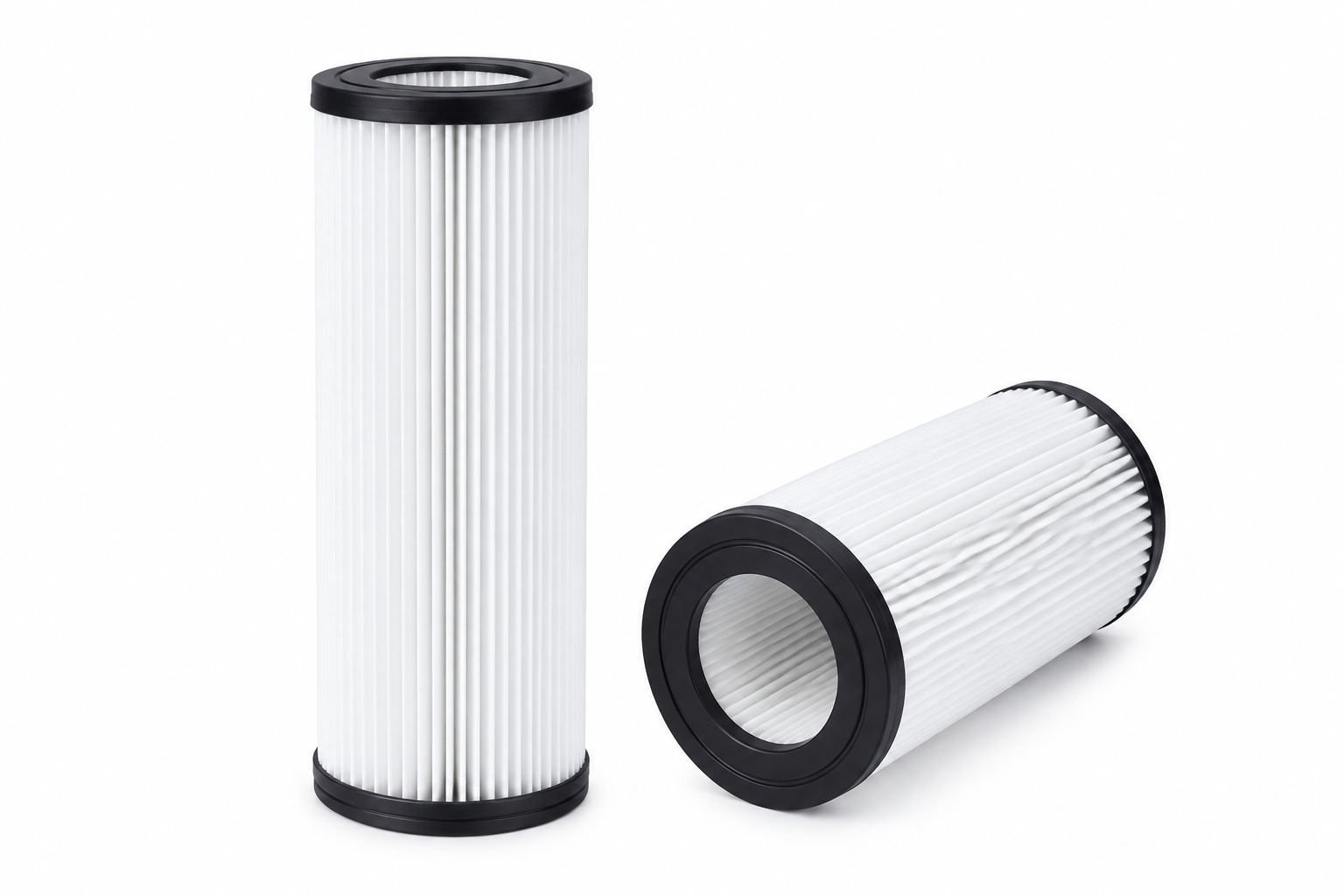
ClearFit manufactures OEM-equivalent cartridges on the same media spec – for example the Hayward C-ool.
The Five Causes, in Order of Likelihood
1. Loaded cartridge (~90% of cases). Dirt in the media is the designed-for pressure rise: the gauge climbing 8–10 psi over weeks of normal operation is the filter working. Pull, clean, reinstall, verify the gauge returns to baseline. If you’re cleaning more often than monthly in-season, your pool is feeding the filter more than it used to — check the variables in replacement timing (bather load, debris, and the wash-life budget).
2. Valves partially closed (the sneaky one). A return-side valve nudged half-closed restricts flow exactly like a dirty cartridge — same gauge symptom, nothing wrong with the filter. Trace the valve manifold after the filter: all return valves fully open? This is the classic post-winterizing or post-service call, when a valve left at 45° from a blow-out procedure quietly redefines “baseline.”
3. Air in the system / partial air lock. Air pockets at the tank top compress and interact with pressure readings erratically; look for the air bubble in the pump’s clear lid, weak return flow, and sputtering. Prime issues trace to the suction side (see the mirror problem below) but present at the tank gauge confusingly.
4. Scale or embedded media (the “clean but still high” case). A cartridge that looks clean after washing but won’t restore baseline pressure has scale deep in the pleats or exhausted media — alkaline then acid soaks per the cleaning chemistry; if pressure still won’t return, the cartridge is at end of wash-life. Replace — and buy by cross-reference number so the new one matches spec (cross-reference guide).
5. The gauge itself. Sunbaked gauges stick, drift, or die at a plausible-looking number. Test: with the pump off, the gauge should read 0. A gauge resting at 4 psi when off overstates everything by 4. Gauges are cheap (~$10–15) and screw into the tank lid assembly — the one instrument failure that imitates every other failure.
Baseline Discipline (Why “Your Normal” Is Yours Alone)
No chart on the internet can tell you your correct operating pressure, because clean-filter psi varies with your pump, plumbing, elevation, and cartridge spec — a system that runs 12 psi clean is healthy, and so is one that runs 18. The only meaningful number is the delta from your own clean baseline, which is why the first action in this entire article is “write down the clean psi.” Mark it on the tank with a paint pen, log it in your phone, or register the filter in the Home Filter Calendar, which tracks clean events and the pressure log alongside replacement timing.
Field baseline examples from the cross-reference world: the same cartridge pattern (say the Pentair CC200’s 200 sq ft cartridge) will run visibly different clean pressures in different installs — flow-dependent, not cartridge-dependent. Comparing your psi to your neighbor’s identical-looking tank is the diagnostic equivalent of comparing fevers by touching foreheads.
The Mirror Problem: Low Pressure, Weak Suction
Read the gauge in both directions. High pressure + normal suction = blockage after the pump (the five causes above). Low pressure + weak returns + air in the pump basket = blockage before the pump — skimmer basket packed, pump impeller clogged, suction valve nearly closed, or a suction-side air leak drawing in air. The two halves share symptoms a pool owner feels (weak circulation) but not symptoms the gauge reports — which is why the gauge is the first thing a pro looks at and the last thing most owners do.
The quick fork: pump basket full of leaves → suction side; basket clear, gauge high → return side; gauge low with sputtering → prime/air on suction side. Thirty seconds at the pad sorts what a chemical-store diagnosis turns into a week of guessing.
FAQ
What psi should my pool filter read?
Your system’s own clean-filter baseline — typically somewhere between 8 and 20 psi depending on pump, plumbing, and cartridge — established right after installing a new or freshly cleaned cartridge. There is no universal “correct” number; only your delta matters: +8–10 psi over baseline is the standard cleaning trigger.
Why is my pool filter pressure high after cleaning?
Three usual suspects: scale or grease deep in the pleats that rinsing didn’t remove (needs alkaline then acid soaks), a cartridge at the end of its wash-life (~20–30 cleanings) that can’t recover flow, or — before blaming the cartridge — a partially closed return valve or a gauge that doesn’t zero when the pump is off.
What psi is dangerous for a pool filter?
Sustained operation above roughly 30–35 psi (check your tank’s max-pressure label): bypass valves force open, lid O-rings and clamps strain, and tank shells are rated around this range. Shut the pump off and resolve the blockage first. A system arriving at this range from a baseline of ~12 has a severe restriction, not a maintenance need.
Does high filter pressure mean the filter is bad?
Usually it means the filter is full — which is the filter doing its job; clean it. The “bad filter” reading is high pressure that cleaning doesn’t restore: embedded scale or exhausted media means cartridge replacement (by cross-reference number). The tank itself is rarely the problem.
Can a pool filter gauge go bad?
Yes — sun and age stick or drift them. The zero test: pump off, gauge should read 0. A gauge resting above zero when off overstates every reading by that amount; replacement is a $10–15 screw-in part. Before any ambitious diagnosis, confirm the instrument.
Sources & References
- Owner-manual conventions (Pentair/Hayward cartridge filter manuals) — the 8–10 psi-over-clean cleaning trigger, tank max-pressure labels. Official documentation (explicit).
- TroubleFreePool Pool School hydraulics pages — suction-vs-return-side diagnosis, gauge discipline. Industry expert analysis (explicit).
- r/pools pressure-diagnosis threads — the no-baseline pattern, valve-at-45° post-winterizing cases, gauge drift reports. Community discussion (paraphrased).
- Cartridge wash-life and scale mechanics — clean-but-high explanation. Official documentation + inference.
Related Guides
- How to Clean a Pool Filter Cartridge — rung one of the ladder.
- How Often to Replace Pool Filter Cartridge — when cleaning stops restoring baseline.
- Pool Filter Cross-Reference — the replacement, by number.
- Pool Opening Checklist — the valve checks in seasonal context.
Find your filter: Pool & spa filter cartridges