How to Open a Pool: the 8-Step Pool Opening Checklist (Plus the Printable and the Failure Preview for Each)

Open when the water holds a steady 60°F+ — not the first warm Saturday, the first sustained warm stretch. Then work this order: remove the cover water (pump it off — don’t scoop it into the pool) → raise the water level → reconnect and prime the equipment → clean/filter → test and balance → run the pump 24 hours → retest → shock. Budget a full weekend. And the decision that shapes the whole season hides in step four: the cartridge you find at opening decides whether you’re cleaning this year or replacing.
The order matters more than the steps. Almost every “my opening went wrong” story on r/pools is a sequence error: shocking a green pool before circulating (algae holds against the walls), balancing chlorine before pH (chlorine is 2–3× less effective above pH 8 — you’re pouring product into water that neutralizes it), opening the equipment before clearing cover debris and flooding the pool with a winter’s worth of phosphate-rich sludge. The checklist below is ordered so each step sets up the next; the failure previews show what skipping each one costs.

Quick Answer: The 8-Step Checklist


| # | Step | Skip it and… |
|---|---|---|
| 1 | Pump the cover water off (cover pump, not a scoop into the pool) | Cover water = a winter of dissolved organics and phosphates — algae fertilizer dumped straight into your pool |
| 2 | Clean & remove the cover; leaf-net anything floating | Debris sinks, stains, and becomes algae substrate |
| 3 | Raise water to mid-skimmer | Pump starves, primes badly, skims nothing |
| 4 | Reconnect equipment, prime, check valves fully open | Post-winterizing valves at 45° read as “high filter pressure” all season (psi ladder) |
| 5 | Cartridge decision: clean or replace (see below) | A spent cartridge makes every later step underperform |
| 6 | Test & balance in order: alkalinity → pH → calcium → chlorine | Wrong order = re-balancing twice; chemistry fights itself |
| 7 | Run the pump 24 h continuously, brush, retest | Products never circulate; readings are lies from still water |
| 8 | Shock, then verify next day | Algae behind the opening wins the first month |
Printable version: the two-page checklist (all eight steps + a spring water-chemistry quick reference) is available as a PDF download — same visual system as the closing checklist, designed to live on the equipment pad wall.
The Season Map: Where Opening Sits in the Pool Year
One picture worth internalizing before the steps — the pool year as your filter experiences it:
| Phase | Months (typical US) | Filter work | Your job |
|---|---|---|---|
| Opening | late Mar–May (when water holds 60°F+) | First full-load run; cleaning #1 | This checklist; clean-or-replace decision |
| Early season | May–Jun | Moderate load | Weekly checks; baseline psi logged |
| Peak | Jun–Aug | Heaviest load — bathing + pollen + heat | Clean at +8–10 psi; watch phosphates |
| Late season | Sep | Falling load, leaf debris rising | Skim aggressively; pre-close inspection |
| Closing | when water falls below 60°F and stays | Final clean + dry storage | Closing checklist |
| Winter | — | Idle | (Closed) or spa-season crossover |
The filter’s year is a load curve, and opening is when you set its starting condition. Which is why step five below gets its own section.
Step 5, the Season-Definer: Clean or Replace the Cartridge
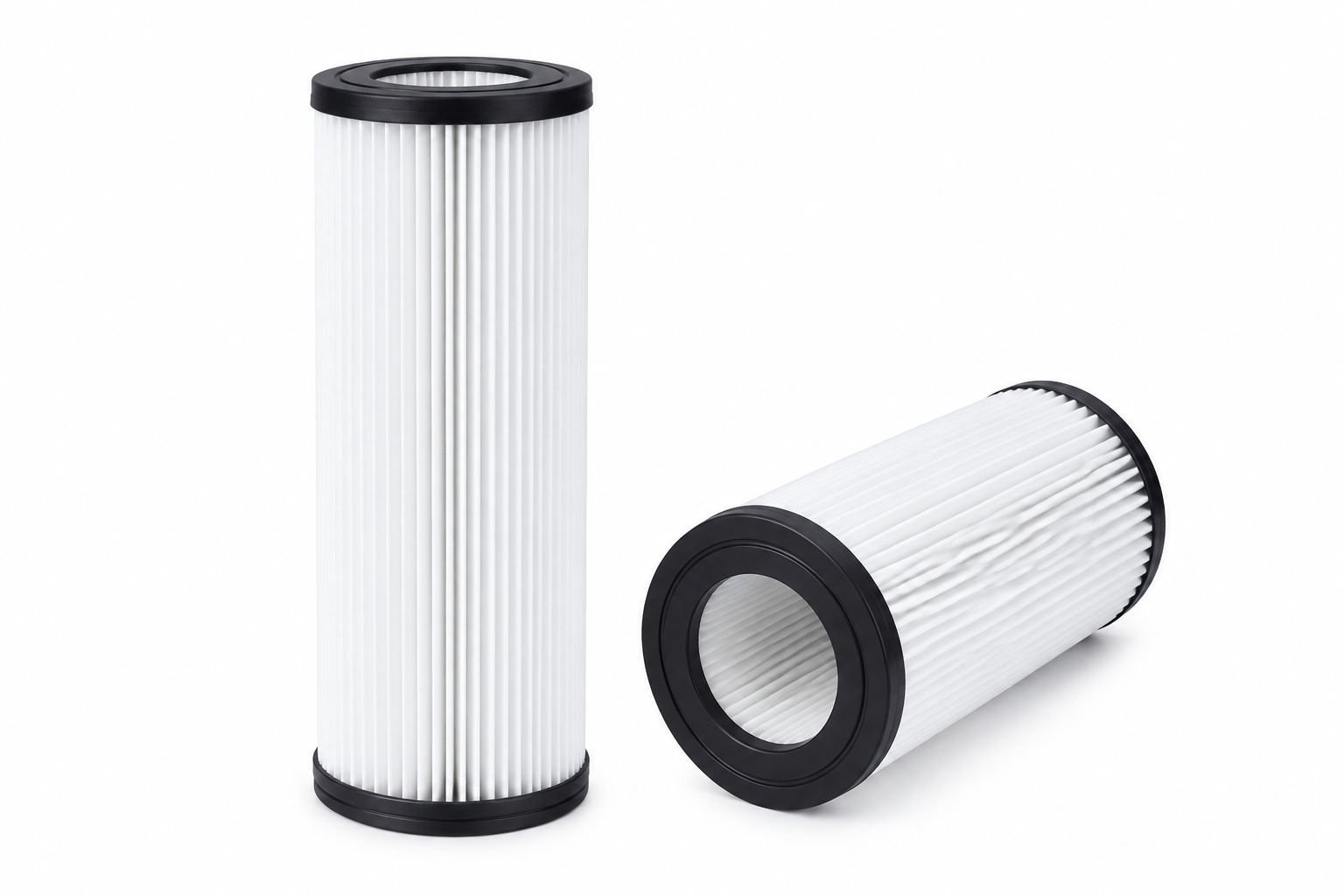
The cartridge that spent winter in the tank (or dried on a shelf) gets its inspection now, before the season depends on it. The decision tree:
- Stored dry, pleats intact, under ~2 seasons / ~20 cleanings → clean it (full chemistry in the cleaning guide) and reinstall. Spring-open a healthy cartridge and it runs the whole season with its full wash budget.
- Any structural failure (torn pleats, cracked end-caps, fused/flattened pleat packs) → replace now, at opening, so the new cartridge serves the entire season — the spring-replacement economics make opening the best timing on the calendar.
- “Clean but pressure never returns to baseline” → the wash-life is spent; replace (buy by the cap number: e.g., a Pentair Clean & Clear 200 takes the Unicel C-9419 / Pleatco PAP200 / Filbur FC-0688 cross-reference row — cross-reference guide, tool).
Log the clean-or-replace event either way: the Home Filter Calendar carries the pool season next to HVAC and fridge schedules, and the pool line item is what turns “when did I last…” into a dashboard answer.
The Water-Chemistry Order (Step 6, Expanded)
Why the sequence is alkalinity → pH → calcium → chlorine, and not whatever order the bottles are stacked in the shed:
- Total alkalinity first — alkalinity buffers pH; adjusting pH before TA is adjusting a number that will move on its own once TA is fixed. Target ~80–120 ppm.
- Then pH — at pH 8.0+, chlorine’s active form (hypochlorous acid) drops to a fraction of its pH-7.5 potency; balancing pH before shocking is the difference between one shock treatment and three. Target 7.2–7.6.
- Calcium hardness — stabilizes water against plaster etching and scaling; rarely urgent at opening, always before the season’s heat. Target ~200–400 ppm.
- Chlorine last — because chlorine’s effectiveness is a function of the two numbers above it. Also check cyanuric acid (stabilizer): too much CYA (50+ ppm) suppresses chlorine’s power all season, and the cheap fix at opening is dilution, not more chlorine.
The pH-chlorine coupling is the single most expensive sequence error in pool care — worth re-reading the row above before step 8.
The opening chemical kit (what to actually have on the pad)
Store “pool opening kits” bundle roughly the right assortment — but buying à la carte from the sequence above is cheaper and skips the filler (most kits include a clarifier you won’t need until after the water is balanced). The chemicals needed for pool opening, in use order:
- Test strips or a liquid test kit (chlorine, pH, alkalinity minimum; add phosphate and copper tests if last season had algae or green-hair episodes)
- Alkalinity increaser (sodium bicarbonate) and pH decreaser — the step-6 pair
- Calcium hardness increaser — plaster pools only
- Chlorine shock — the step-8 workhorse; budget 2× if the pool opened green
- Phosphate remover — only if the test says 500+ ppb
- Chelated-copper algaecide (not plain copper) — seasonal maintenance dose
Salt-water pools add one opening-specific check: verify the SWG cell is clean and the controller reads the water temperature — most salt chlorine generators don’t produce chlorine below ~60°F water, so the opening shock is still manual chlorine even on a salt pool.
The Green Pool & the Phosphate Note (Spring’s Two Classic Problems)
Green water at opening means algae established under the cover — usually because the pool closed warm (the #1 spring-algae mistake; see closing checklist for the fix at the other end). The opening response: brush walls and floor, run the pump continuously from step 7, shock at dusk, and repeat the shock-versus-verify cycle until the water holds chlorine overnight. Only then does clarifier/floc make sense. The cartridge will load visibly during a green-water opening — check it mid-process; a clearing pool can cake a filter in days (pressure ladder).
Phosphates — algae’s fertilizer — enter with cover water (step 1’s whole point), decaying leaves, and fill water. High phosphate levels (500+ ppb) don’t harm swimmers, but they let algae regrow the moment chlorine dips. Test at opening; if high, phosphate remover now, before the heat arrives, and the season’s algae fights get shorter. industry expert analysis (documented phosphate-algae relationship)
And the one cosmetic-scare FAQ every pool season generates, worth pre-answering here: blonde hair turning green is copper, not chlorine — dissolved copper (from algaecides or heater elements) plates onto hair in chlorinated water. If it shows up early in the season, test for copper, and prefer chelated-copper algaecides. It’s a water-chemistry signal, not a hair-product problem.
FAQ
Is opening an above ground pool different from an inground pool?
The chemistry sequence is identical — same 60°F trigger, same alkalinity→pH→calcium→chlorine order, same 24-hour circulation before shocking. What changes above ground: equipment is usually smaller (an above-ground pump and cartridge filter prime differently, so fill the strainer basket before starting), the cover is often a looped winter cover rather than a safety track, and there’s no main drain, so point a return jet downward to help circulate the floor water a still inground pool would move through the main drain. Inground pools add the equalizer line and winterizing plugs to reconnect in step 4.
When should I open my pool?
When the water temperature holds a steady 60°F+ — typically late March through May depending on region. Opening too early wastes chemicals on water too cold to balance efficiently; opening too late lets algae establish under the cover. The trigger is sustained temperature, not the first warm weekend.
What are the first steps of opening a pool?
Pump the cover water off (don’t scoop it into the pool), clean and remove the cover, raise the water level to mid-skimmer, then reconnect and prime the equipment with all valves verified fully open. Chemical balancing comes after circulation is established.
Should I clean or replace my filter cartridge at opening?
Clean if it’s structurally sound with wash-life left (under ~2 seasons / ~20 cleanings) — a healthy cartridge should serve the full season. Replace at opening if pleats are torn/fused, caps are cracked, or cleaning no longer restores baseline pressure — opening is the best replacement timing on the calendar because the new cartridge runs the entire season.
Why is my pool green when I open it?
Algae grew under the cover — usually because the pool was closed before water dropped below 60°F (closing warm), or winter chemistry lapsed. Response: brush, circulate continuously, shock at dusk, and repeat until the water holds chlorine overnight. The filter loads fast during a green opening; check it mid-process.
Do I shock the pool when opening?
Yes — as step 8, after balancing and 24 hours of circulation, not before. Shocking still, unbalanced water wastes product: pH above 8 neutralizes most of the chlorine before it works. Verify the next day that the pool holds its chlorine level; if not, repeat rather than escalate products.
Sources & References
- Pool-industry opening guidance (TroubleFreePool Pool School; manufacturer opening guides) — 60°F trigger, chemistry order, cover-water practice. Industry expert analysis (explicit).
- Water-chemistry references — chlorine speciation vs pH (hypochlorous acid fraction), TA/pH buffering dependency, phosphate-algae relationship. Industry expert analysis (explicit).
- r/pools opening threads — cover-water pump-vs-scoop debates, green-opening recoveries, valve-at-45° post-winterizing pressure cases. Community discussion (paraphrased).
- Cross-reference dataset — Unicel C-9419 / Pleatco PAP200 / Filbur FC-0688 row for the CC200 example. Cross-reference database data (explicit).
Related Guides
- Pool Closing & Winterizing Checklist — the other half of the cycle.
- How to Clean a Pool Filter Cartridge — step 5, clean branch.
- Why Is My Pool Filter Pressure High? — the baseline you log today.
- How Often to Replace Pool Filter Cartridge — the replace branch.
Find your filter: Pool & spa filter cartridges