How to Clean a Pool Filter (Cartridge Method, and the Pressure Washer Mistake That Silently Kills It)

Rinse at 45° with a garden hose — never a pressure washer, which shreds the pleat media and the filter fails silently while looking clean — then soak overnight in an alkaline cleaner for body oils and sunscreen, or dilute acid for white mineral scale, rinse again, inspect the pleats for tears, and reinstall. When to clean is not a calendar question: clean when the filter pressure reads 8–10 psi above your clean baseline, not “every month” and not “when it looks dirty.”
Cartridge cleaning is the highest-volume pool-filter how-to search there is — “clean pool filter” and its cartridge variants add up to well over 40,000 searches a month, and most of what ranks for it is half right. The rinse-and-soak sequence gets repeated everywhere; the two things that actually decide whether your cleaning extends the cartridge’s life or ends it — the chemistry of what you’re removing, and the psi trigger for when to do it — are the parts that get skipped. The distinguishing detail of good pool ownership is knowing your filter’s clean psi by heart. One r/pools regular put the whole discipline in one line: “If you don’t know your clean pressure, your gauge is decorative.”
A note on scope: this page covers the cartridge method — the dominant filter type and the one the “how to clean a pool filter” question is really asking about. Sand and DE filters are cleaned by backwashing, a different procedure with its own valve sequence — if your tank is full of sand or grids rather than a pleated cartridge, that’s the guide you want.
Quick Answer: Clean Trigger & Method Table

| Signal | What it means | Action |
|---|---|---|
| Gauge at +8–10 psi over clean baseline | Media loaded — the manufacturer-standard cleaning trigger | Full clean cycle (below) |
| Visible gray felt on pleats, weak returns | Same thing, later stage | Clean now; note baseline next time |
| White, crusty deposits on pleats | Calcium/mineral scale | Alkaline wash plus acid soak (dilution below) |
| Greasy film, slimy pleats | Body oils, sunscreen, bather waste | Alkaline cleaner soak — acid won’t touch organics |
| Pressure climbs right back within days | Media exhausted or scale deep in the pleats | Deep soak; if it repeats, replace (how often to replace) |
| “Every Sunday” | Calendar habit | Fine for light pools — but the gauge is the real trigger |
The Five-Step Clean Cycle
1. Rinse (garden hose, 45°, pleat-by-pleat). Pull the cartridge, rinse from top to bottom at a 45° angle down the pleat valleys — a standard fan-spray nozzle at garden-hose pressure, not a turbo jet. Work each pleat channel; the felted surface layer holds most of the captured mass and releases with direct flow. Hold the nozzle close enough to matter but never narrow enough to cut: the media is polyester Reemay-style fabric, and it is tougher than it looks in your hand and weaker than it looks against a pressure washer jet.
2. Soak overnight — matched to the deposit. This is the step that separates cleaning from rinsing:
- Alkaline cleaner (sodium-based cartridge cleaner, or a dish-detergent soak for light oil) for organic film: body oils, sunscreen, pollen slime, bather waste. Alkaline chemistry saponifies oils — breaks them into water-soluble residues the next rinse carries out.
- Dilute acid for mineral scale: the white crust is calcium carbonate, and acid dissolves it — muriatic acid at roughly 1:10 in water (always add acid to water, never water to acid), or citric acid as the friendlier alternative. Acid does nothing to organics; using it on an oily cartridge cleans the scale and leaves the grease.
- Heavily neglected cartridges need both: alkaline soak first, rinse, then a short acid dip for the scale the alkaline pass exposed.
3. Second rinse. After the soak, rinse until the water runs clear and odorless. Residual cleaner in the media dumps straight into your pool water at startup.
4. Inspect. Fan the pleats and look for tears at the pleat roots, hard flat spots where pleats have fused, cracks in the top and bottom end-caps, and a loose or stretched core. A torn pleat is a bypass channel: water flows through the tear unfiltered, which means the cartridge looks installed and functions as decoration. Also check the pressure gauge while you’re at the tank — a gauge that doesn’t drop to baseline after a clean cartridge is a failed gauge, not a persistent problem.
5. Reinstall and log the clean psi. Reassemble the tank (lubed O-ring, evenly tightened lid bolts), start the pump, bleed air, and write down the psi the gauge settles at. That number is your new baseline — the entire future of “when do I clean” hangs on it.
Why the Pressure Washer Destroys a Cartridge (the Mechanism)
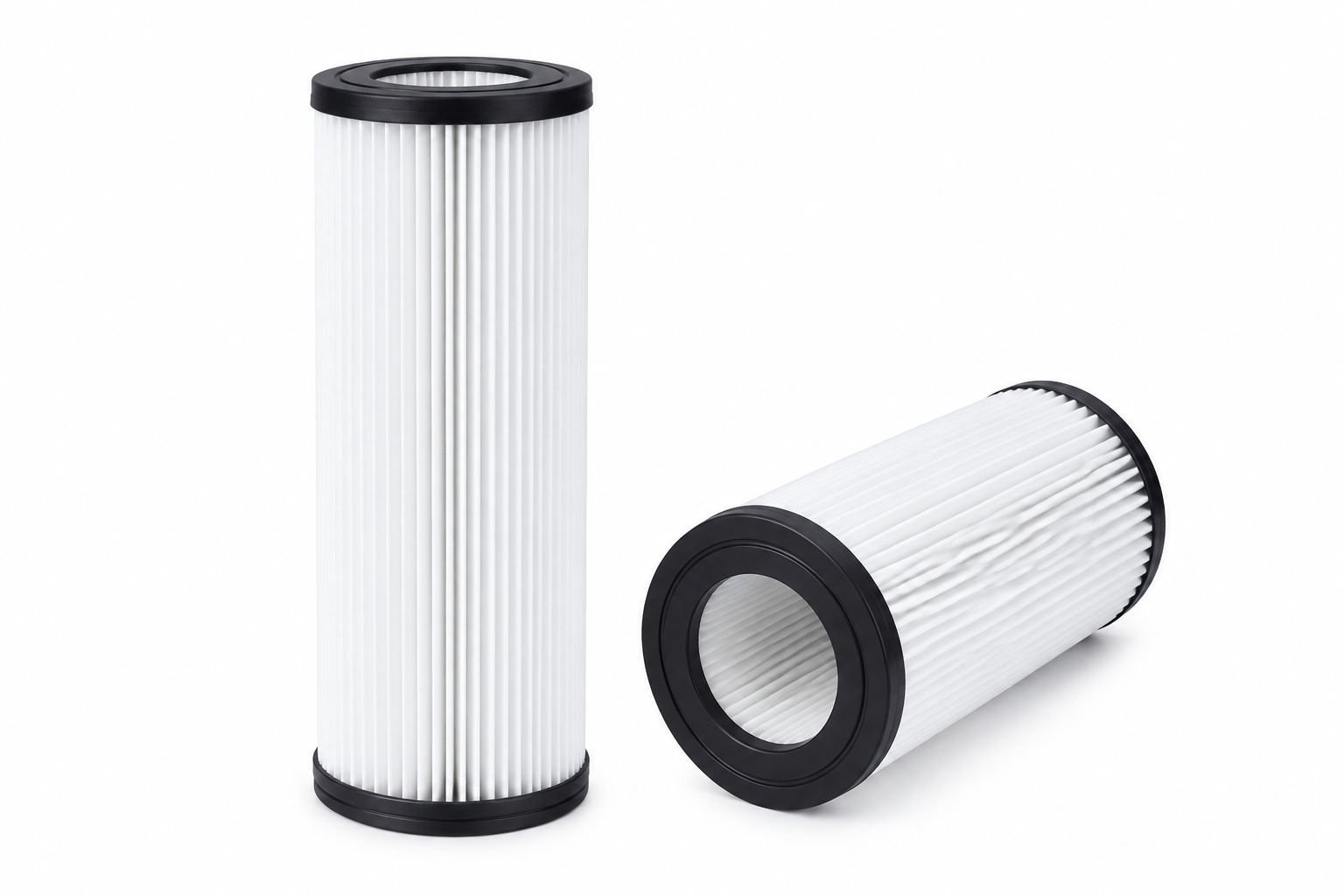
Every guide says “don’t pressure wash.” Almost none say why, which is why people keep doing it — a caked cartridge looks like it needs force. The mechanism: cartridge media is a spun-bonded polyester fabric thermally bonded into a pleat pack. The fibers form an interlocked web whose pore structure is the filtration. A pressure-washer jet at 1,500–3,000 PSI hits that web with orders of magnitude more energy than the ~50 PSI max the fabric ever sees in service, and it slices fiber bonds along the pleat valley — the highest-velocity line of the jet’s path.
The failure is silent and structural: the visible result is a beautifully clean-looking white pleat (the cake is gone, the sheared fibers still look like fabric), but the pore structure in the jet line is now a channel of enlarged openings. Flow recovers, pressure drops back toward baseline, everything seems fixed — and the cartridge now passes the fine particles it was bought to stop. Pool goes cloudy, you blame chemistry, the cartridge sits there looking innocent. inference from media-structure mechanics, consistent with industry consensus: pressure-washed cartridges pass the eye test and fail the turbidity test.
The same logic forbids stiff brushes (scrub the end-caps, never the media), car-wash wands, and “just this once” turbo nozzles. The garden hose at 45° with patience is the entire approved toolkit.
Alkaline vs. Acid: the Chemistry Split (and Why Mixing Up the Order Wastes a Cleaning)
| Deposit | Chemistry that removes it | Soak | Notes |
|---|---|---|---|
| Body oils, sunscreen, lotion | Alkaline (cartridge cleaner, ~pH 12 products) | Overnight | Saponifies organics into rinseable residues |
| White scale crust (calcium carbonate) | Acid (muriatic 1:10, or citric ~1 lb/5 gal) | 1–4 h (acid acts faster) | Effervescence = scale dissolving; stop when bubbling stops |
| Algae green staining | Chlorine-based cleaner or dilute bleach rinse, then alkaline | Short | Kill first, then clear the organic film |
| Iron/metal staining (rust tones) | Acid soak (citric is gentlest) | 1–2 h | Prevents the stain becoming permanent in the media |
Order matters when both problems coexist: alkaline first, acid second. Acid on an oily cartridge reacts with the organics and wastes itself; the alkaline pass strips the oil so the acid can reach the scale. One more field tip from the r/pools archives: a five-gallon bucket with a lid is the correct soaking vessel, and a brick on top keeps a floating cartridge submerged — a detail that sounds trivial until you’ve weighted one down with a broom handle at 9 PM.
When Cleaning Stops Working: the Replacement Signals
A cartridge is a consumable with a wash-life budget — manufacturers typically quote ~20–30 cleaning cycles before the pleat structure fatigues. The end-stage signals: pressure climbing back within days of a thorough clean (deep-embedded scale and exhausted media), permanently fused or flattened pleats, end-cap cracks, and a core that flexes. At that point cleaning is theater and the money question becomes replacement timing — full treatment in how often to replace your pool filter cartridge, including the spring-opening economics.
When you do replace, buy by OEM part number first, measurements second: the number printed on the end-cap (Unicel C-9419 for a Pentair Clean & Clear 200, for instance) maps directly to exact-fit replacements across brands — Pleatco PAP200 and Filbur FC-0688 are the same cartridge by cross-reference. The lookup takes thirty seconds: pool filter cross-reference explains the three numbering systems, and the cross-reference tool does it in one step. Popular cartridges live on their size pages — e.g., /pool-filter-cartridges/pentair/cc200/.
FAQ
Is cleaning a Hayward or Pentair pool filter any different?
No — the best way to clean a pool filter is brand-agnostic because the cartridge inside a Hayward Star-Clear, a Pentair Clean & Clear, or any other tank is the same pleated polyester media. Rinse at 45° with a garden hose, soak in alkaline cleaner (acid only for scale), rinse, inspect, reinstall, and reset your clean-psi baseline. What does differ by brand is the replacement cartridge part number you reorder when the wash-life runs out — Hayward uses their own numbering, Pentair tanks take Unicel/Pleatco/Filbur cross-references (see the cross-reference guide).
Can I clean a pool filter cartridge with muriatic acid?
Yes — for mineral scale only, at roughly 1:10 acid-to-water, in a plastic bucket, 1–4 hours until the effervescence stops. Always add acid to water, wear gloves and eye protection, and never use acid as the first step on an oily cartridge: alkaline cleaner first for organics, acid second for scale. Acid on a greasy cartridge wastes itself and cleans nothing.
Can I clean my cartridge with a pressure washer?
No. A pressure-washer jet slices the fiber bonds in the pleat media — the cartridge looks clean afterward but the enlarged pores pass fine particles permanently. Garden hose at 45° with a standard spray nozzle, pleat by pleat, is the correct tool; it takes longer and it’s the only method that doesn’t destroy the media.
Can pool filter cartridges go in the dishwasher?
No. Dishwasher detergent chemistry, high heat, and the jet action combine the worst of the wrong cleaner and the pressure washer. Heat warps end-caps; detergents leave films that foam into pool water. The approved chemistry is alkaline cartridge cleaner and a hose.
How do I know it’s time to clean — not replace?
Clean if the cartridge is structurally sound and pressure fell properly after the last cleaning. Replace when pressure rebounds within days of a clean, pleats are torn or fused, end-caps are cracked, or you’re past roughly 20–30 wash cycles on that cartridge. The gauge pattern — not appearance — is the deciding signal.
What’s the black line / gray felt on my pleats?
The gray felt is the captured debris load doing its job — it rinses out. A persistent black line at the pleat root is often algae colonizing the media or metal staining; treat with the chlorine/citric approaches in the chemistry table before considering replacement.
Sources & References
- Cartridge manufacturer care guidance (Unicel/Pleatco/Filbur care sheets) — hose-rinse methods, ~20–30 cycle wash-life, chemistry recommendations. Official documentation (explicit).
- Pool chemistry references (TroubleFreePool Pool School cleaning guides) — alkaline-vs-acid division, psi triggers. Industry expert analysis (explicit).
- r/pools cleaning threads — pressure-washer regret reports, bucket soaking practice, gauge-baseline discipline. Community discussion (paraphrased).
- Spun-bonded polyester media structure — fiber-bond shear mechanism under high-PSI jets. Inference (media construction mechanics).
- Cross-reference data — Unicel C-9419 / Pleatco PAP200 / Filbur FC-0688 equivalence for Pentair Clean & Clear 200. Cross-reference database data (explicit).
Related Guides
- How Often to Replace Pool Filter Cartridge — when cleaning stops being the answer.
- Why Is My Pool Filter Pressure High? — the full diagnostic behind the trigger.
- Pool Filter Cross-Reference — buying the replacement by number.
- Pool Opening Checklist — the season’s first clean, in sequence.