Hot Tub & Spa Filter Care: Rinse Weekly, Soak Monthly, Replace on a Two-Cartridge Rotation

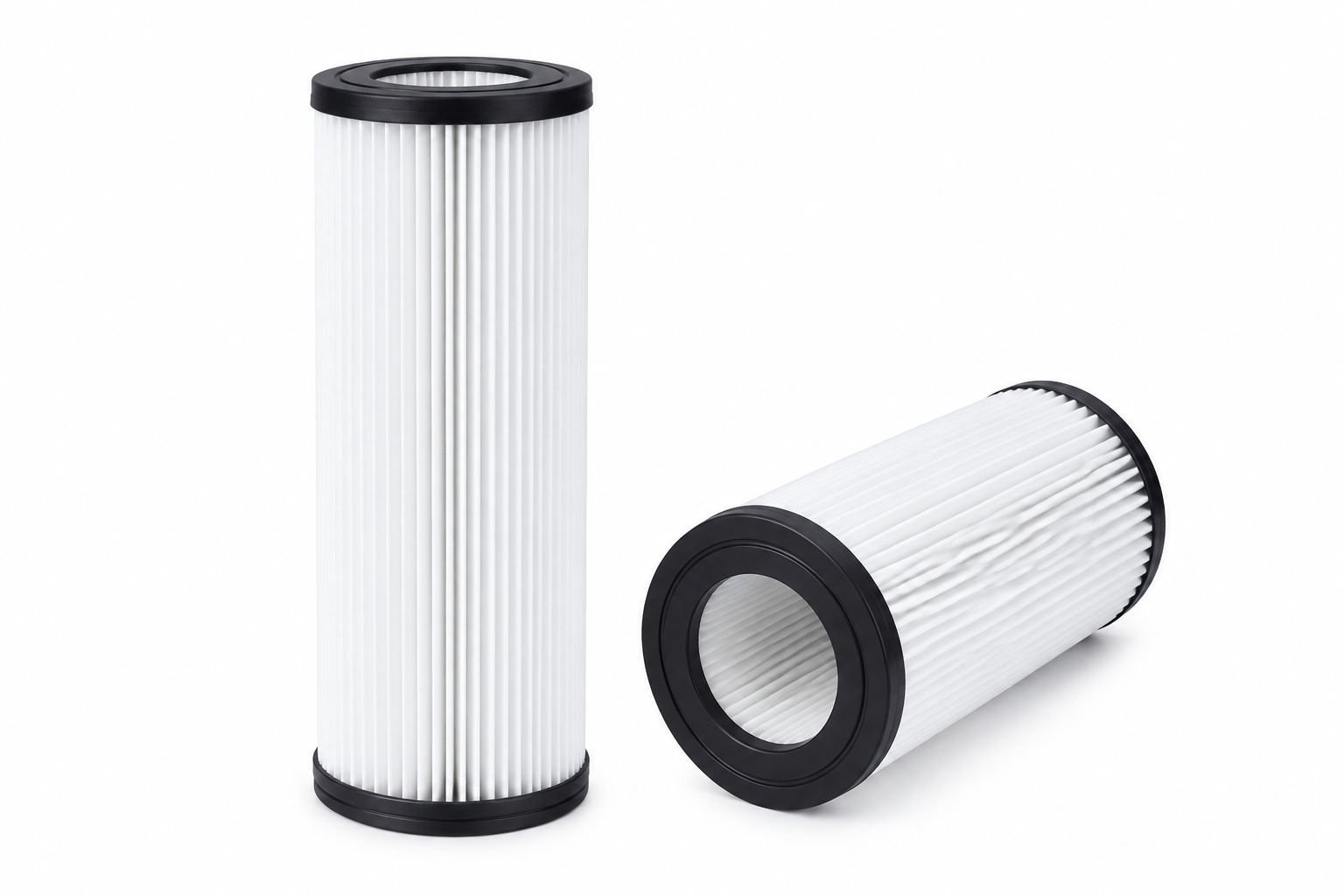
Spa filter care runs on a compressed clock — rinse weekly, deep-soak monthly, replace every 12–18 months — because a hot tub is not a small pool: four people in a 350-gallon spa load the water with more bather waste per gallon than a hundred swimmers in a pool, at temperatures that melt body oils into the water column continuously. The method that makes the schedule livable: the two-cartridge rotation — one filter in the tub, one clean and dry in reserve, swapped on a rhythm that eliminates the “reinstall damp” failure entirely. The chemistry is the same as pool cartridge care (the full method); what changes is frequency, the enzyme lane’s usefulness, and the replacement clock.
The r/hottub regulars have the ratios memorized: spa water is roughly 1% bather load by volume versus a pool’s fractions of a thousandth — the reason a spa cartridge comes out slick with body oil after weeks where a pool cartridge looks merely dusty after a season. The Reddit threads on “a better way to clean filters” and “tips for cleaning without the expensive stuff” are spa owners trying to outrun that load with dish soap and vinegar — solutions that work, with spa-specific boundaries this page draws precisely (Dawn’s rinse discipline, vinegar’s scale-only scope, the dishwasher’s hard no).
Quick Answer: The Spa Filter Clock

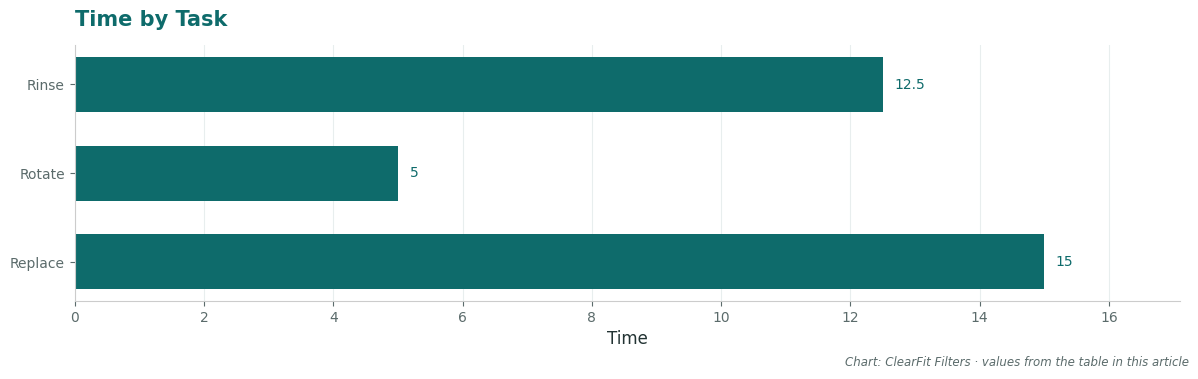
| Task | Frequency | Method | Time |
|---|---|---|---|
| Rinse | Weekly (2× under heavy use) | Garden hose, 45°, pleat-by-pleat — never a pressure washer | 10–15 min |
| Deep soak | Monthly-ish (on the oil clock, not just calendar) | Alkaline cleaner overnight (chemistry ranked here); acid step only if scaled | Overnight + 15 min |
| Rotate | At every soak | Second cartridge goes in; soaked one dries at leisure | 5 min |
| Replace | Every 12–18 months; sooner at wash-life signs | Buy by end-cap part number (cross-reference) | 15 min |
The gauge discipline applies where spas have one (pressure-trigger logic) — but most spa owners run the calendar-plus-look method: weekly rinse scheduled with water care, deep soak when the pleats stay slick after a rinse.
Why Spa Load Outruns Pool Logic (the Arithmetic)
The bather-load ratio is the entire story. A residential pool holds 15,000–25,000 gallons serving a family; a spa holds 300–500 gallons serving the same bodies at 100+ °F. Per gallon, a spa evening deposits orders of magnitude more sweat, skin oils, lotion, and detergent residue — and heat keeps those organics fluid and water-soluble instead of trapped in surface films. The filter sees the difference directly: spa cartridges gray and slick within weeks, and the pleat-root oils mineralize into felt if left between monthly soaks.
Two consequences follow. First, the enzyme lane earns its cost in spas in a way it doesn’t in most pools: continuous low-level enzyme dosing breaks the oil flux down before it loads the media, visibly stretching the interval between deep soaks (the chemistry). Second, water chemistry and filtration are coupled more tightly — oily water foams, and foam complaints trace to filter load as often as to chemistry imbalance; a fresh-soaked cartridge often fixes “foam problems” that shock didn’t.
The Deep Soak, Spa Edition
The full cartridge method (pool version) applies with spa-specific notes:
- Alkaline soak overnight in a five-gallon bucket (spa cartridges are smaller — a weighted lid or brick keeps one fully submerged). Purpose-built spa/cartridge cleaners or the Dawn-class DIY lane both belong here; rinse until zero suds remain, because spa volumes are small enough that detergent residue measurably foams the tub.
- Acid step only for scale: white crusty deposits (hard-water spas are common — the heater accelerates precipitation). Citric-acid class is the friendly route in a small-bucket context; if scale recurs, the story is water chemistry, and the filter is just the messenger.
- The order rule holds: oily-and-scaled cartridges go alkaline first, then acid — acid on an oil layer wastes itself.
- Dry fully before storage: the rotation cartridge lives dry in a closet; a damp-stored spare is a mold starter kit.
What Not to Do (the Spa-Specific Banned List)
- The dishwasher. Heat warps spa cartridge end-caps (which are often the mounting interface — warpage means vibration and bypass), detergent chemistry foams the tub on reinstall, and jet action attacks pleat roots. It’s the “cleaning” method that damages all three failure surfaces at once.
- Pressure washing. Same media mechanics as pools: the jet slices fiber bonds; the cartridge looks clean and filters worse. Garden hose, 45°, patience.
- Gasoline-class solvents and stiff brushes. Media and adhesives degrade; end-cap glue seams especially.
- Vinegar as the whole cleaning program. Vinegar (acetic acid) handles light scale and little else — it does nothing to the oil load that dominates spa filters. The “vinegar tip” threads work when the cartridge was scaled; they fail when it was oily, and the failure gets blamed on the filter.
Brand Notes and Buying (the End-Cap Number Is the SKU)
Spa cartridges are bought by the part number on the end-cap, and the spa market’s brands (Sundance, Bullfrog, Hot Spring, Caldera, Cal Spa, Master Spas, Arctic, Viking, Coleman) each run their own numbering — with cross-references into the Unicel/Pleatco/Filbur aftermarket systems exactly like pool cartridges (the cross-reference method; the brand comparison). The rotation strategy means buying two from the start: one on duty, one in reserve — and spa cartridges’ smaller size makes the pair affordable. Verify the microns/sq-ft spec when buying aftermarket (spa filters vary more than pool filters in media area at the same footprint); the cross-reference number keeps you honest.
FAQ
What is the best way to clean spa filters?
Weekly garden-hose rinse at 45° pleat-by-pleat, monthly overnight alkaline soak matched to the oil load (purpose-built cleaner or the Dawn-class DIY lane with thorough rinsing), acid step only when scale is present, and the two-cartridge rotation so a dry spare is always ready. The full procedure with the why at each step: how to clean a pool filter cartridge — the method is identical; the spa difference is frequency and the enzyme lane.
Can you use Dawn dish soap to clean hot tub filters?
Yes, as the light-to-moderate DIY alkaline lane — dish detergent is an optimized degreaser and the chemistry is right for body-oil load. Two spa-specific disciplines: keep the dilution reasonable (~1–2 oz per five-gallon bucket), and rinse until absolutely zero suds remain — spa volumes are small enough that residue foams the tub visibly. For season-slick cartridges, the purpose-built concentrates are stronger per soak (the cleaner comparison).
Can I use vinegar to clean my hot tub filters?
For light mineral scale only — vinegar is a mild acid and dissolves calcium deposits; it does nothing to body oils, which are the dominant spa filter load. Use it (or citric acid, which is stronger and equally safe-handling) when the pleats are white and crusty; use alkaline chemistry when they’re gray and slick; both in that order when they’re both. A vinegar-only program on an oily spa filter is cleaning the scale off the oil, so to speak.
What can you use to clean your spa filter?
The matched-chemistry short list: alkaline cleaner (branded cartridge/spa cleaner or Dawn-class DIY) for oils and organics; citric acid or dilute muriatic for scale; enzyme products as the maintenance lane between soaks; and a garden hose as the weekly constant. Not on the list, ever: dishwashers, pressure washers, gasoline solvents, and stiff brushes — each destroys a different part of the cartridge (the banned list).
Sources & References
- Spa manufacturer care guidance (Sundance/Hot Spring/Master Spas-class manuals) — filter service intervals, rotation recommendations. Official documentation (explicit; model-level per manual).
- Bather-load ratio conventions — spa vs pool waste-per-gallon arithmetic. Industry convention (explicit order of magnitude).
- Cleaning chemistry classes — alkaline saponification, acid scale dissolution, enzymatic maintenance (companion analysis). Industry analysis (explicit mechanism).
- r/hottub cleaning threads — the Dawn-and-vinegar DIY canon, the two-filter rotation practice, foam-complaint tracing. Community discussion (paraphrased).
Related Guides
- How to Clean a Pool Filter Cartridge — the base method.
- Best Pool Filter Cleaners Compared — what goes in the soak bucket.
- Pool Filter Cross-Reference — buying the replacement by number.
Shop this guide: Pool & spa filter cartridges